If you have ever run Meta Ads and felt like a campaign was invisible one day and unstoppable the next, the most useful way to understand that shift is to stop thinking linearly.
A better model is threshold-aware media buying. In many machine learning systems, improvements do not show up smoothly. They show up when the system has enough confidence to act. That is why campaigns can feel flat for days and then suddenly stabilize.
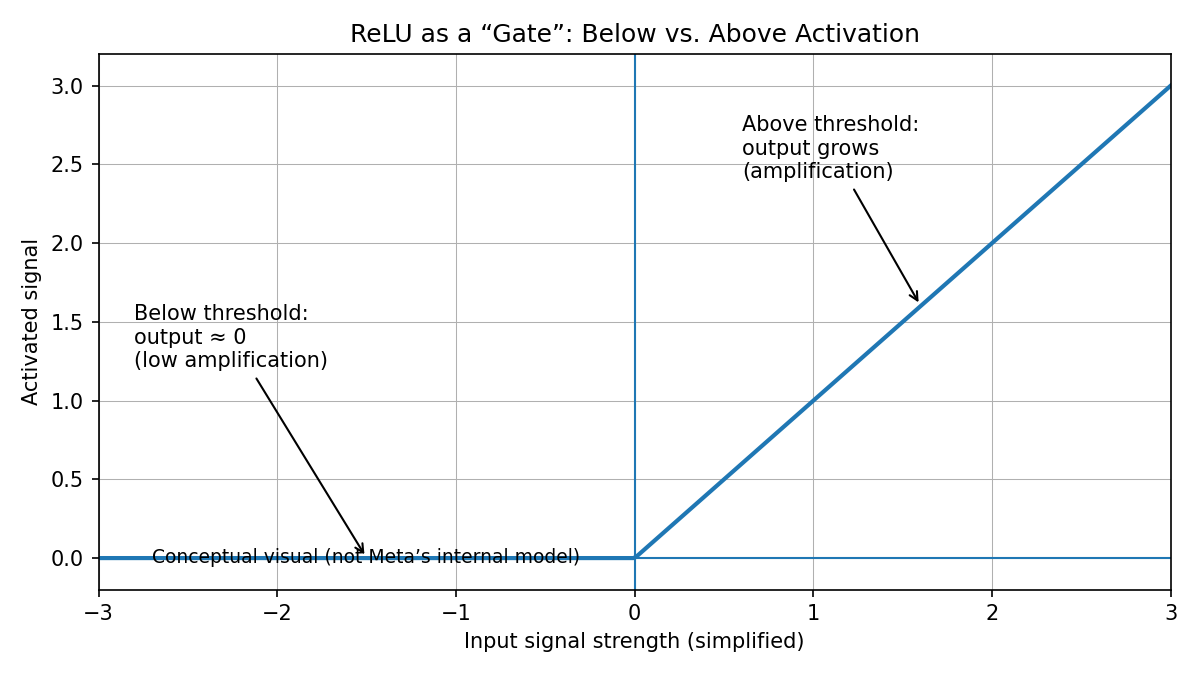
1) ReLU as the gate
ReLU means:
- Below the line: output is effectively zero.
- Above the line: output starts to grow.
Applied to media buying, that becomes: weak signals lead to uncertain predictions and noisy delivery, while strong signals create confident predictions and more stable delivery.
2) Why Meta feels nonlinear
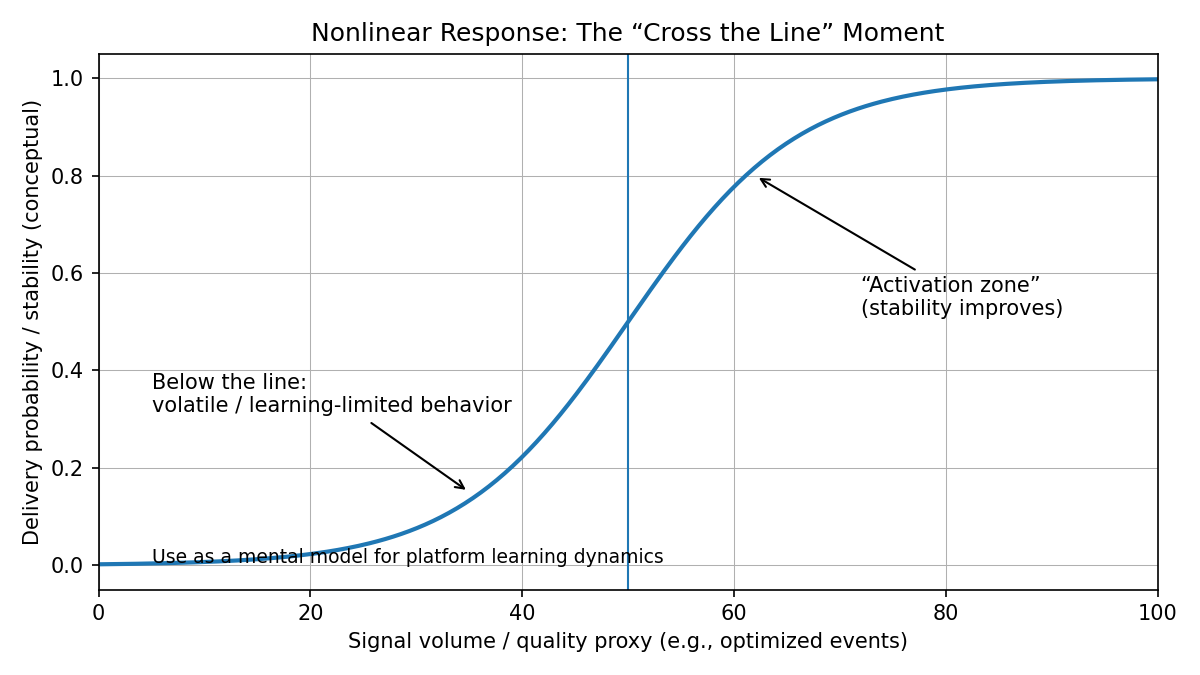
Meta’s auction is not simply “highest bid wins.” In practice, outcomes reflect the interaction between bid, predicted action rate, and quality signals. That is why many teams see a familiar pattern in Ads Manager:
- slight structure changes do nothing,
- then one change crosses a line,
- delivery stabilizes,
- and CPA or ROAS stop swinging as wildly.
3) Signal density is the lever you can control
Most accounts do not struggle because the creative is “bad.” They struggle because feedback is diluted across too many variables and too many micro-tests.
Too many ad sets, thin budgets, constant edits, mixed objectives, weak measurement.
Fewer optimization units, concentrated budgets, one clear path to conversion, stable inputs, clean measurement.
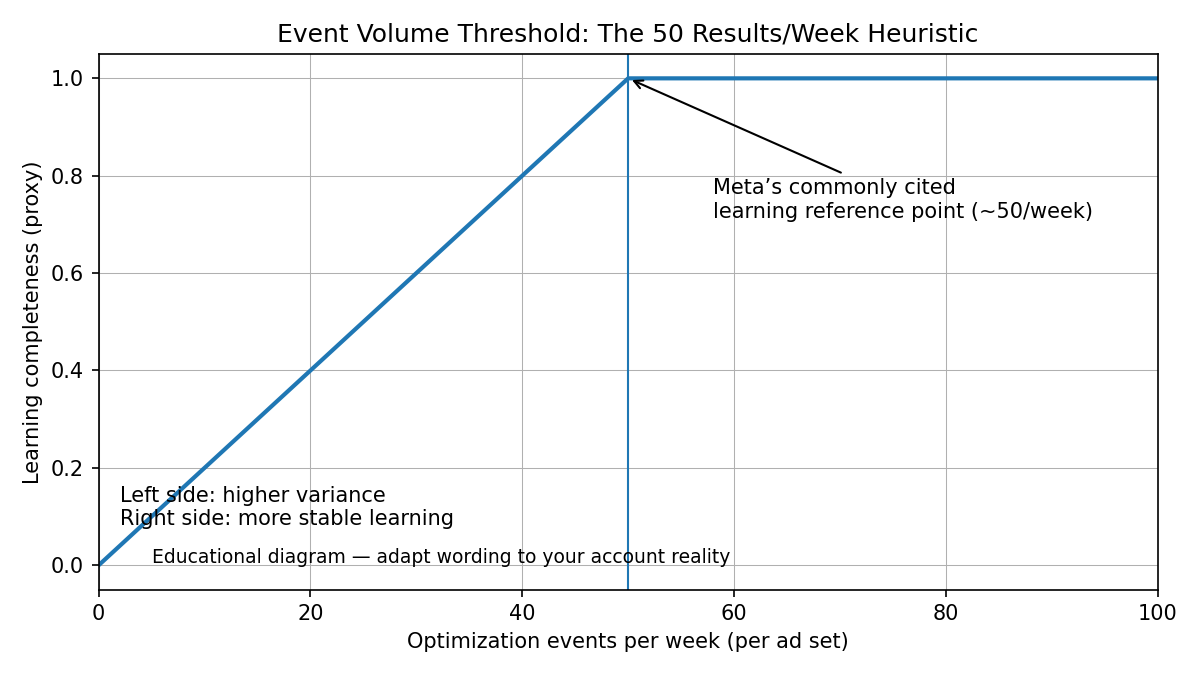
A useful planning heuristic is to think in terms of enough optimization events per week per ad set to reduce variance. The exact number matters less than the principle: volume + consistency reduce noise.
4) Go deep before you go wide
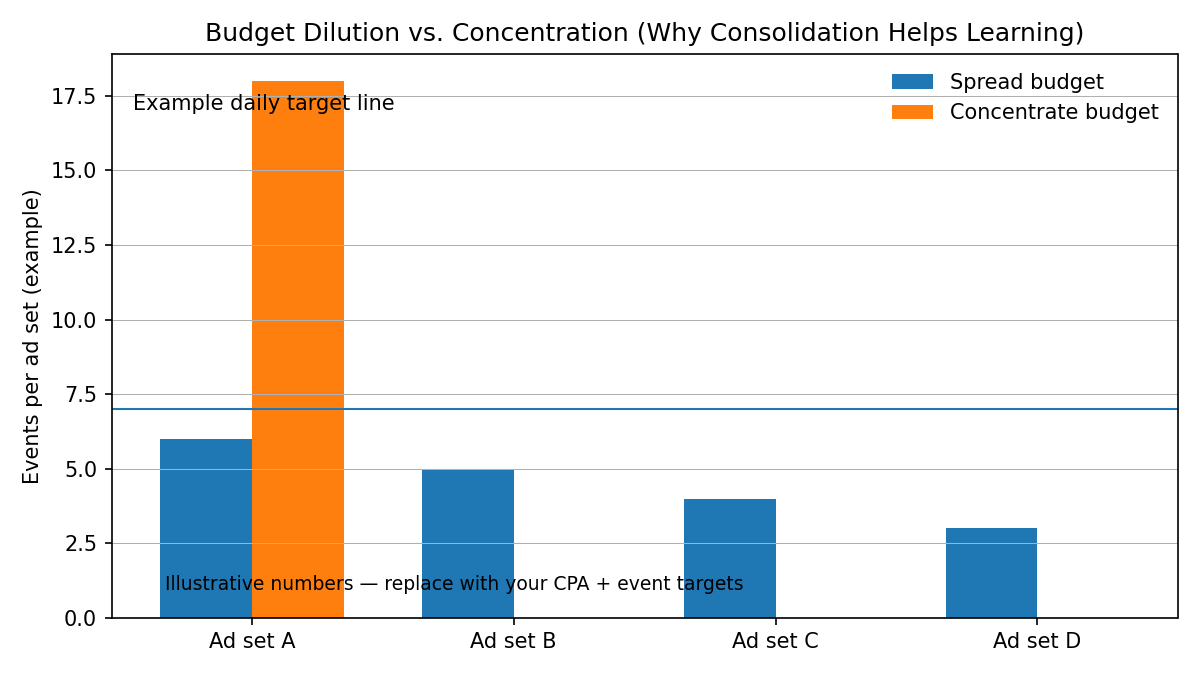
This is the single most important operational rule. Instead of spreading budget thin across many ad sets, concentrate budget so at least one optimization unit gets dense, clean feedback.
- Use fewer ad sets.
- Put more budget behind each optimization unit.
- Keep the objective clean.
- Maintain one clear conversion path.
- Stabilize tracking with Pixel + Conversions API where possible.
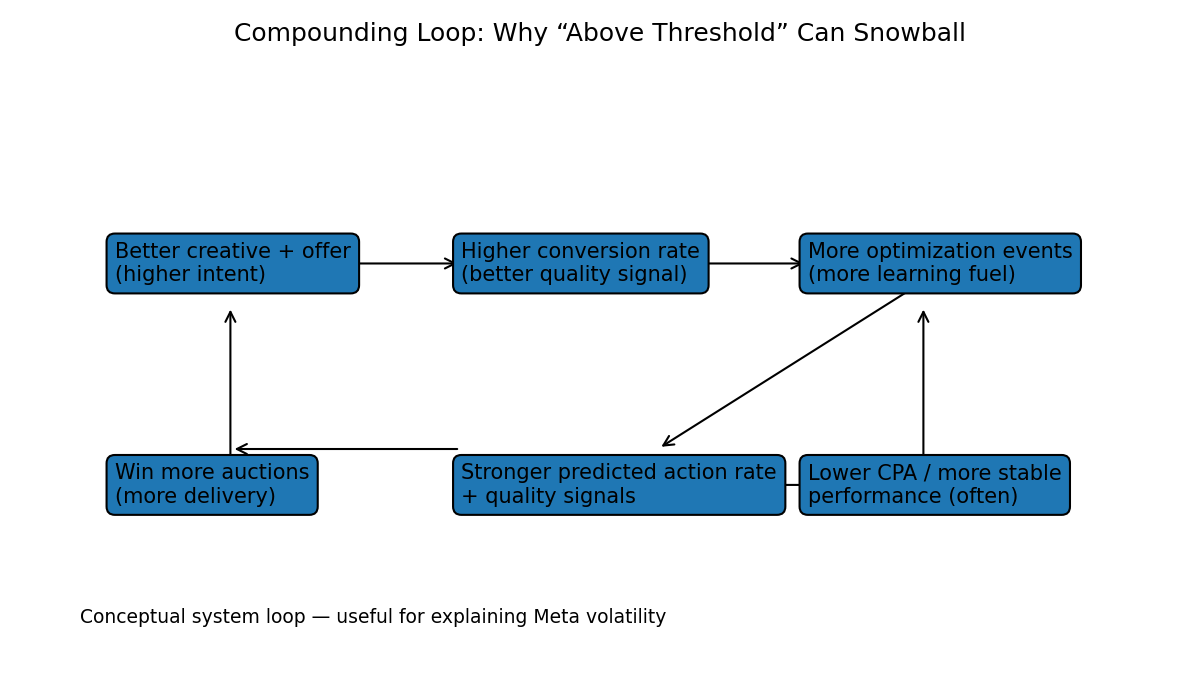
5) The compounding loop
Above threshold, outcomes can snowball. Better creative and offers raise conversion rate. Higher conversion rate creates more optimization events. More events strengthen predictions. Stronger predictions improve auction outcomes. Better auction outcomes create more learning fuel.
6) How MIZ OKI 3.5 operationalizes this
MIZ OKI 3.5 already frames media buying as a threshold-aware decision problem.
- Learning phase detection: detect when ad sets are trending toward instability before performance degrades.
- Signal quality optimization: monitor tracking quality, deduplication, and funnel completeness.
- Institutional memory: store what changed, what worked, and under what conditions in the temporal-causal knowledge graph.
- Stability windows: protect learning by limiting disruptive edits during critical periods.
- Counterfactual simulation: evaluate alternatives before budget moves, not after performance breaks.
7) A practical launch sequence
Days 1–7: build signal density
- Start with best creative.
- Start with highest-intent audience.
- Limit variables.
- Do not thrash the structure.
Days 8–14: expand carefully
- Broaden only after stability appears.
- Keep spend anchored to winners.
- Introduce one new variable at a time.
Day 15+: optimize for efficiency
- Scale in steps.
- Refresh creatives without changing the core promise overnight.
- Tighten controls only after stability is proven.
8) The real takeaway
If you treat Meta like a linear system, you keep asking why more spend did not produce more results.
If you treat it like a threshold system, you build differently:
- cross the activation line early,
- stay above it,
- compound the advantage.