A focused commercial application of MIZ OKI
MIZ OKI Media
Causal Growth Control · powered by the MIZ OKI Decision Graph
Know why performance moved. Put the next dollar where it creates profit.
Modern organizations have more commercial data than ever before, yet the most important decisions are still made through disconnected dashboards, spreadsheets, intuition, and meetings. MIZ OKI Media transforms fragmented commercial signals into governed decisions that people can understand, approve, execute, and continuously improve.
MIZ OKI Media connects media, commerce, customer experience, inventory, product economics, and policy into one governed decision pathway.
MIZ OKI Media is a focused commercial application powered by the broader MIZ OKI Operating Knowledge Intelligence platform — one product surface on the same governed decision infrastructure, not a separate company.
- Signal
- Entity
- Cause
- Objective
- Policy
- Action
- Outcome
The customer problem
The Most Expensive Decisions Are Still Guesswork
Commercial teams are surrounded by data and still cornered by the same questions — asked in meetings, answered by intuition, owned by nobody in particular.
- Why did CPA suddenly increase?
- Why did ROAS fall?
- Is creative responsible?
- Is the website responsible?
- Did tracking break?
- Are we inventory constrained?
- Is margin preventing profitable scale?
- Is this seasonal noise?
- Should we increase budget?
- Should we pause campaigns?
- Who should approve the decision?
Every one of these questions resolves the same way: one governed decision pathway.
The gap in the stack
Why existing tools stop too early
Each layer of the modern stack does its own job well — and stops before the decision is actually governed, authorized, executed, and learned from. None of this is a criticism of any particular vendor; it is a description of where each category ends.
| Decision lifecycle step | Dashboards | Attribution | CDPs | Bid Automation | MIZ OKI Media |
|---|---|---|---|---|---|
| Detect change | Yes | No | No | Yes, within a single platform | Yes |
| Store customer data | No | No | Yes | No | Yes, as decision-linked evidence |
| Estimate attribution | No | Yes | No | No | Yes |
| Identify likely causes | No | No | No | No | Yes |
| Compare counterfactual actions | No | No | No | No | Yes |
| Apply financial rules | No | No | No | Yes, within a single platform | Yes |
| Apply policy | No | No | No | No | Yes |
| Route approval | No | No | No | No | Yes |
| Execute governed action | No | No | No | No | Yes |
| Measure realized outcome | Yes | No | No | No | Yes |
| Learn from every decision | No | No | No | No | Yes |
* Within a single ad platform's auction. In-platform automation detects change, applies its financial targets, and executes changes there — capably — but without organization-level margin, inventory, policy, approval routing, or cross-stack context, which is what "governed" means in this table.
† MIZ OKI Media stores customer-linked evidence with identity and provenance for decision-making; it complements a CDP's profile store rather than replacing it.
Data warehouses retain all of this data, durably. What no existing layer retains is the complete chain — evidence, reasoning, authorization, action, outcome — of why a decision was made, who approved it, and what happened next. That chain is what MIZ OKI Media preserves.
The substrate
The Decision Graph
Traditional knowledge graphs organize relationships. The MIZ OKI Decision Graph preserves the complete lifecycle of every business decision — each stage a first-class object: inspectable, explainable, and preserved.
Every recommendation remains connected to:
- evidence
- business context
- objectives
- governing policy
- responsible authority
- action taken
- realized outcome
Signal
A change worth attention — media metrics, commerce events, experience telemetry, inventory movement, or an economic threshold.
Entity
The signal resolves to the real things it concerns: campaigns, products, audiences, pages, warehouses, ledgers.
Cause
Candidate explanations are tested against the evidence — with the supporting and disconfirming evidence preserved.
Objective
What the business is actually optimizing here — incremental profit, margin protection, growth within constraints.
Policy
Financial floors, brand rules, risk boundaries, and authority thresholds that any proposed action must satisfy.
Action
The authorized intervention — scoped, bounded, dispatched to the executing system, and recorded.
Outcome
The realized result, compared against the prediction, written back into memory.
A conventional knowledge graph explains what is connected. The MIZ OKI Decision Graph preserves the evidence, causal reasoning, objective, policy, decision, action, and realized outcome — so the organization can govern and learn from decisions.
Four layers of memory
Evidence memory
The observed signals and their provenance — what was known, when it was known, and where it came from.
- source
- timestamp
- provenance
- confidence
- quality
- identity
Operating context
The living map of entities, relationships, constraints, and economics the business runs on.
- entities
- relationships
- objectives
- constraints
- policies
- organizational state
Decision memory
Each decision with its reasoning, the alternatives considered, the policy checks applied, and who authorized it.
- hypotheses
- counterfactuals
- recommendations
- approvals
- vetoes
- actions
Outcome memory
Predicted versus realized results — the feedback that makes the next decision measurably better informed.
- realized impact
- prediction accuracy
- lessons
- future weighting
- model improvements
Four layers, one graph — a complete decision record spans all four, and no layer can drift out of sync with the others.
The definitive Decision Graph page — comparisons, properties, and a full worked record →How it works
How MIZ OKI Media works
Every MIZ OKI Media decision moves through the platform's seven-stage operating loop, in this exact order — and every stage leaves a record. Select any stage to see its purpose, inputs, outputs, and value.
SENSE → REASON → PLAN → VALIDATE → DECIDE → ACT → LEARN
1 · SENSEDetect meaningful commercial change.
Notice the changes that matter — and ignore the noise that doesn't — the moment they emerge.
Media metrics, commerce events, experience telemetry, inventory movement, and economic thresholds — normalized into structured evidence with provenance.
A qualified signal: what moved, where, by how much, and with what evidence quality.
Change is noticed while it is still cheap to answer — not at the month-end review.
2 · REASONEvaluate competing hypotheses.
Diagnose why performance moved, instead of assuming the loudest metric is the culprit.
The qualified signal plus operating context — entities, relationships, constraints, and decision history.
Ranked candidate causes, each with its supporting and disconfirming evidence preserved.
The organization argues from shared evidence, not from whichever dashboard was opened first.
3 · PLANGenerate multiple possible interventions.
Lay out the plausible responses — including doing nothing — and compare their expected outcomes against each other.
The diagnosed cause, the business objectives, and the levers actually available to pull.
A counterfactual comparison set: each candidate action with its expected effect and stated assumptions.
Decisions are chosen against alternatives, never defaulted into.
4 · VALIDATEApply organizational constraints.
Hold every candidate action against the rules the business governs itself by — before it reaches a decision-maker.
The candidate actions plus configured policy, financial floors, and authority boundaries.
A pass-or-fail record per constraint — vetoes recorded, never silent.
A proposed budget shift that would breach the margin floor is vetoed before it ever reaches a decision-maker — and the veto itself is recorded.
Nothing out-of-bounds can travel further, and the check itself is preserved as part of the decision.
5 · DECIDERoute the recommendation to the correct authority.
Put the decision in front of whoever actually holds the authority to make it — a person, a delegated rule, or a bounded automation.
The validated recommendation and the organization's authority map.
A budget shift that crosses the configured autonomous ceiling routes to the media lead by name; one inside the ceiling proceeds under its delegated grant, and either way the authority is recorded.
Autonomy only where explicitly granted — a named human everywhere else.
6 · ACTExecute the governed action.
Dispatch only the authorized action — scoped, bounded, and with its rollback path preserved.
The authorized decision, its scope, and the executing system's contract.
A dispatched, logged intervention — or a recorded decision to hold.
"No action" is a first-class outcome — restraint is recorded with the same rigor as action.
7 · LEARNCompare predicted with realized outcomes.
Close the loop: measure what actually happened against what was predicted, and adjust.
The decision's recorded prediction and the realized outcome from the field.
- Predicted outcome
- Actual outcome
- Confidence adjustment
- Future weighting
Updated calibration written into outcome memory — visible on every future recommendation it informs.
A rebalance predicted to recover most of the lost efficiency recovers less than expected; confidence in that action class is adjusted down, and the next recommendation says so.
The adjusted weighting feeds the Decision Graph, so the next SENSE starts from a smarter baseline. Memory compounds.
A decision, end to end
One performance movement. One governed answer.
This is the shape of a MIZ OKI Media decision — what the system observes, which explanations it rules out, and what it asks a human to authorize. Illustrative scenario
What moved
- Blended CPA +34% ▲ Illustrative Example
- Creative CTR stable —
- Landing page latency increasing ▲
- Checkout abandonment increasing ▲
- Hero-SKU inventory constrained
What the graph ruled out
- Creative fatigueCTR stable across cohorts ruled out
- Tracking failureevents verified against server-side records ruled out
- Audience saturationreach and frequency steady ruled out
- Seasonal noiseoutside the seasonal baseline envelope ruled out
- Landing page performancelatency rise precedes the abandonment rise confirmed
- Inventory constraintcompounds the loss on the hero SKU confirmed
What the graph concluded
The 34% movement — and every value in this scenario — is an illustrative example. It demonstrates the decision pathway; it is not verified production performance.
Fifteen decision jobs like this one, by the team that owns them →The explainer film
Watch the decision pathway unfold
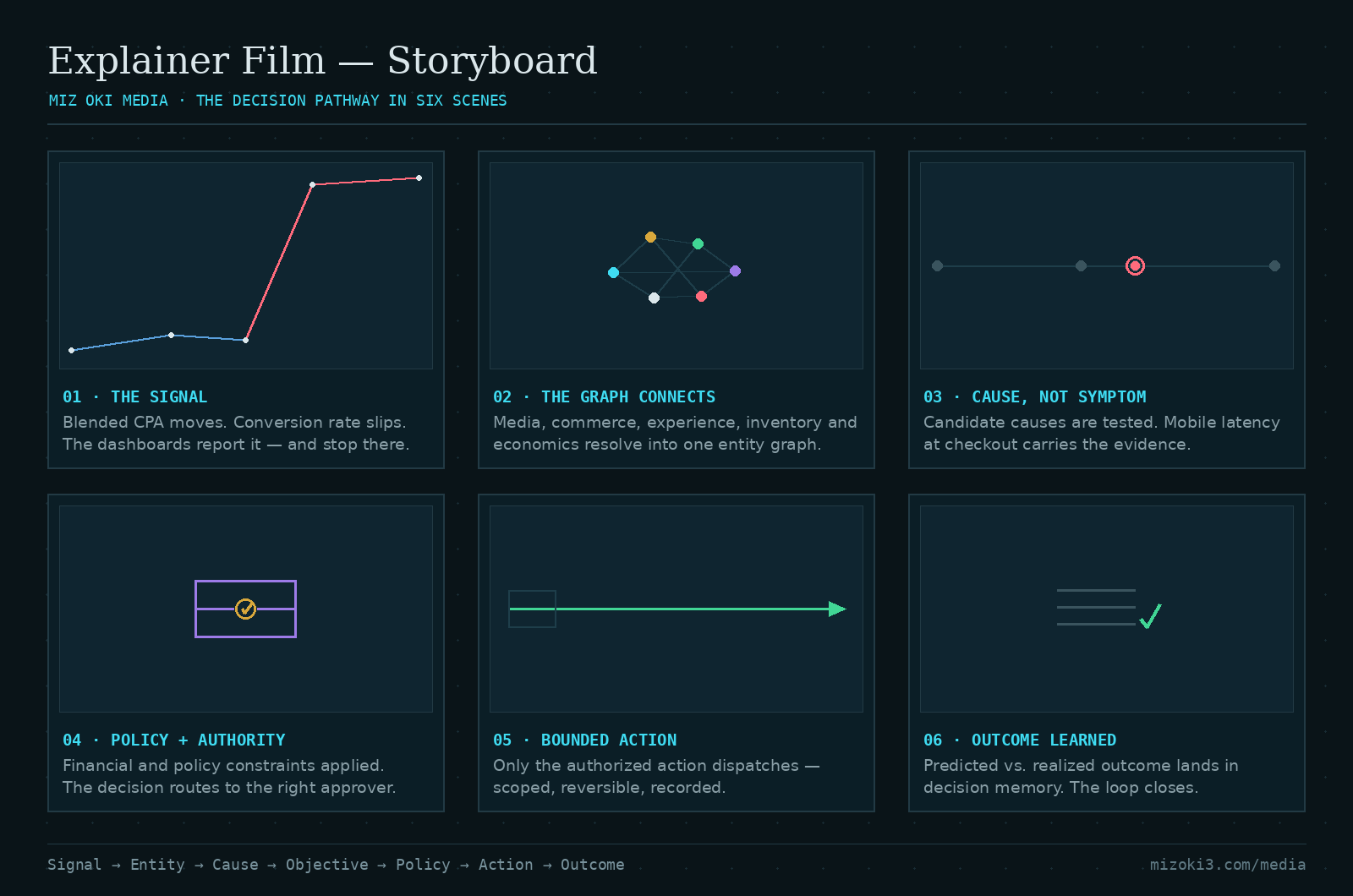
Seven scenes, one governed pathway. A signal moves. The graph finds the cause. Policy applies. The right person authorizes. The bounded action dispatches. The outcome is written to memory. Watch it happen.
Behind the film
The storyboard
Six story scenes — the spine of the explainer film, from first signal to recorded outcome.
One recommendation, three owners
Every leader gets the answer they own
A governed decision is only useful if the people who own its consequences can each see their question answered inside it.
Marketing Leaders
Know where incremental growth exists.
Which spend is creating demand that would not have happened anyway — and which spend is buying what was already coming.
Finance
Know where profitable growth exists.
Whether the next dollar clears margin and cash constraints — established before it is committed, not discovered after.
Operations
Know whether execution is possible.
Whether inventory, fulfillment, and site experience can actually carry the demand the plan would create.
All three converge into one governed recommendation — the same evidence, the same constraints, one authorized action.
What it's for
High-value decision jobs
MIZ OKI Media is built for the recurring, expensive decisions where the cause is cross-functional and the response needs governance.
Detect and prevent media waste
Catch spend that is buying outcomes which would have happened anyway — or buying nothing at all — before the month closes.
Pilot-readyDiagnose conversion deterioration
Separate creative, audience, pricing, experience, and infrastructure causes when conversion slips — before the wrong lever gets pulled.
Pilot-readyAllocate budget by incremental profit
Move the next dollar toward where evidence says it creates profit — not toward whichever channel claims the most credit.
Pilot-readyCoordinate media with inventory and margin
Stop accelerating demand into products that cannot be fulfilled profitably — and lean in where stock and margin allow.
Pilot-readyIdentify tracking and infrastructure failures
Distinguish a real performance change from a broken pixel, a consent change, or a slow page — before optimization chases a phantom.
Pilot-readyCompare causes across the funnel
Weigh channel, creative, audience, and experience explanations against each other on shared evidence, not in separate tools.
Pilot-readyProtect brand and policy boundaries
Keep every proposed action inside configured brand, financial, and risk boundaries — with the check recorded, not assumed.
Pilot-readyLearn which interventions work, where
Build an institutional record of which actions produced which outcomes under which conditions — memory that compounds.
RoadmapHonesty, structurally
Evidence and maturity labels
Everything on this page — and everything in a MIZ OKI Media engagement — carries one of four labels. We do not blur the line between demonstrated functionality and future capability.
Running in production on the MIZ OKI platform today, with verifiable behavior.
Built and exercised on the platform; validated against your data and constraints during a pilot before it carries weight.
A worked example that demonstrates the pathway. Its numbers are constructed for clarity, not measured results.
Planned capability. Discussed as direction, never sold as present functionality.
On this page: the decision scenario and the explainer film are Illustrative; the decision jobs are labeled individually; the 90-day pilot below is the Pilot-ready path into everything else.
The platform beneath
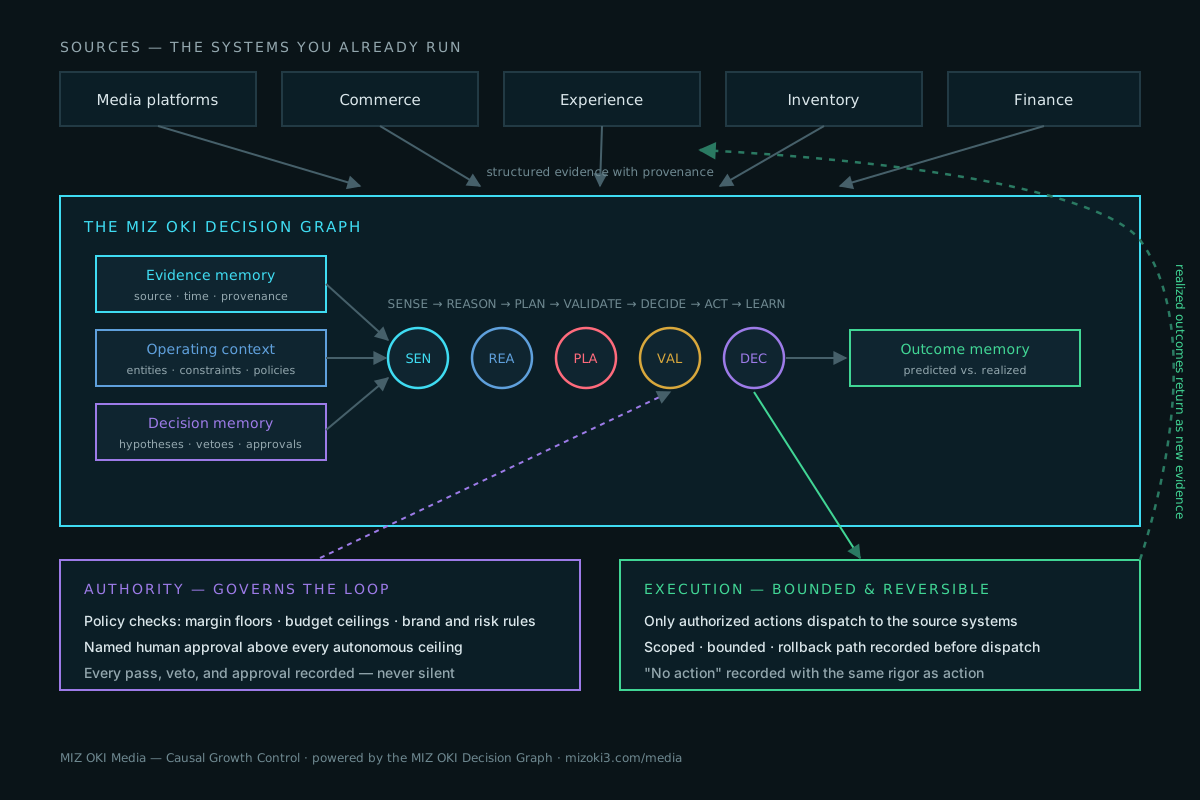
Platform architecture
Sources in, governed decisions out, outcomes back in. Your systems keep their jobs — the Decision Graph holds the decisions together, and authority governs the loop.
The way in
A 90-Day Causal Growth Control Pilot
Begin observe-only. Advance to human-approved actions only after evidence quality, economics, and policy boundaries are validated. Pilot-ready
Pilot scope
- One brand or business unit
- Limited media and commerce sources
- One performance-incident decision class
- One budget-allocation or profit decision class
- Explicit evidence boundaries
- Explicit human authority
- Observe-only starting mode
- Human-approved actions only after validation
- Measured predicted-versus-realized outcomes
- Clear expansion criteria
Connect and observe
- Confirm source access
- Map critical entities
- Establish canonical event definitions
- Validate identity, timestamps, and economics
- Run in observe-only mode
Diagnose and recommend
- Generate causal hypotheses
- Compare counterfactual actions
- Apply policy and economic constraints
- Present human-review recommendations
- Measure recommendation quality
Approve, act, and learn
- Enable narrowly scoped approved actions
- Preserve rollback paths
- Track realized outcomes
- Compare prediction against reality
- Produce pilot evidence and expansion recommendation
Autonomy is earned, never assumed: the pilot starts observe-only, and every advance in authority is a deliberate, human-made decision backed by the pilot's own evidence.
The full pilot structure — metrics, checkpoints, and exit criteria →Trust before AI
Trust & governance
Trust comes from governance, not automation. AI contributes inside the rails — never around them.
Human authority
Named approvers, delegated rules, bounded grants. Observe-only is the default everywhere; nothing acts outside an explicit grant.
Policy enforcement
Margin floors, budget ceilings, brand and risk rules checked on every candidate action — every veto recorded, never silent.
Audit trail & replay
Append-only decision records, re-walkable end to end with the evidence as it stood at the time.
Rollback
The rollback path is recorded before an action dispatches — and rollback authority always stays human.
Next step
Ready to know why — and act on it?
Tell us about your stack and the decision that costs you the most when it goes ungoverned. We'll scope a 90-day pilot around it.